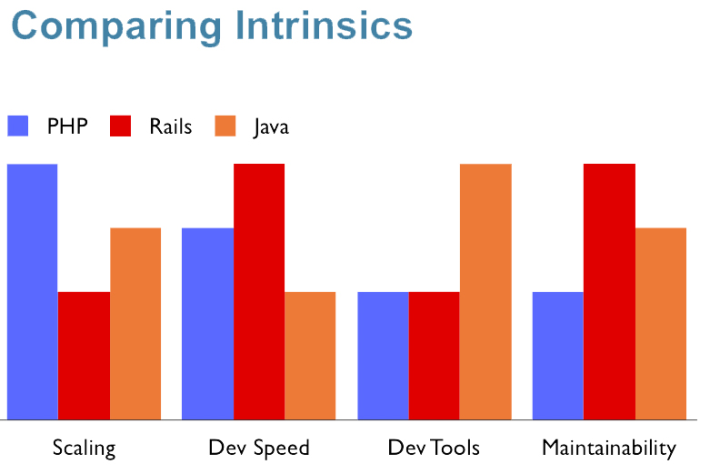
 A firestorm was set off on a TSS thread about a slide from Tim Bray's keynote at a PHP conference with a bar graph showing PHP more scalable than Java. Tim Bray has since put the slide in context in a comparison intrinsic qualities of Java, Rails, and PHP on his blog, as well giving InfoQ his own personal take on it. The context for the discussion is Web Application Building, which Tim characterizes as a problem space in which "we are not considering general issues of compute performance, because in Web apps, you don’t do much computing. You get some values from the browser, you use them to pull some info out of a database, you report them to the user, maybe you update the database, and that’s about it."
InfoQ asked Tim about some of the more surprising conclusions of his intrinsics comparison:
InfoQ: Why is Rails more maintainable than Java?
Mostly because there's less code. The fact that Ruby *forces* MVC on you helps too, also the fact that the templating and ORM and testing and application code are all so tightly integrated helps. Bear in mind that we still don't know how well Rails is going to work outside of the CRUD-centered greenfield app space where it shines.InfoQ: Why is PHP more scalable than Java?
It isn't, but in the Web-app space, it's a little easier to scale (shared-nothing by default); Java requires you to think.InfoQ: So which intrinsic is more important to you?
For me, maintainability; but I'm sure there are lots of other people who would make different choices for very good reasons.Tim also explained the maintainability point further on his blog:
Out there in the wild woolly “Web 2.0” world, maybe getting it built quick is all that matters, because after you’ve knocked ’em dead and been acquired, you can use the money from the Yahoo! buy-out to rebuild everything right the second time. In the enterprise though, I kind of suspect that smart developers and smart managers know that for real apps, the big development cost starts to happen after they’re delivered.You can also see Tim Bray on InfoQ's video interview with him on Rails, Rest, Java, and XML.