Dynamic language support is becoming an increasingly common part of Java IDEs. NetBeans 6 has Ruby integration, Eclipse has the DLTK and Aptana, and IntelliJ IDEA 7 offers support for Ruby as well as support for Groovy and Grails (it made its first appearance in milestone 2 and will coming out of beta shortly). The support includes:
Groovy code editor with advanced coding assistance, smart completion, code quality maintenance with intelligent code inspections, quick-fixes, refactorings and more, all tied together to create an excellent Groovy and Grails development environment.
In addition to code completion and navigation, refactoring, syntax and error highlighting, code formatting, folding, factoring and debugging in Groovy code, IDEA also offers Grails generators, Groovy Server Pages (GSP) support, and even a ER diagram of your Grails model classes.
Reactions have generally been positive. Glen Smith experimented with JetGroovy, and said:
I'm only a week in, but the things I use all the time are the quick switch options between Domain/Controller/View/Test for a given object. That saves so much time... (in screengrab below I have everything related to the Entry domain class instantly onscreen)
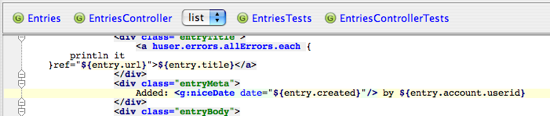
Bart suggested that the plugin could "singlehandedly get people playing with Grails and Groovy. Looks like a winner."
On the other hand, Shawn Hartsock rates the Groovy plugin, "Not Quite Good Enough":
The plugin is painfully close to being useful without actually getting in my way. When it comes down to it I must be able to declare my domain classes in packages and the JetBrains plugin can't handle that. Importing existing Grails projects is also more than a gigantic pain. If not done just right you lose all the nifty editor decorations that help with navigation. Also, if you alter your domain model to not use the "default" package you lose the navigation decorators and the ability to generate Controllers and Views inside the IDE.
He did say that it's a great first attempt, but that it's wasn't quite where he wanted it to be.
For more information, watch the demo, a presentation by Eugene Vigdorchik, a developer for JetBrains, and the Grails IDEA Integration documentation.