InfoQ

News

JaBoWS, JBoGS and PoPS are just Stepping Stones

Posted by Hartmut Wilms on Mar 27, 2008 04:52 PM

Community
SOA
Topics
Enterprise Architecture,
Governance,
Web Services

Jeff Schneider writes about the evolution of SOA initiatives.

Recently Nick Malik has called upon the SOA community to stand up against JaBoWS (Just a Bunch of Web Services) as the cornerstone of an Enterprise SOA effort. Jeff does not agree, he has "determined that JBoWs is the natural first step that an organization takes on the path to service orientation".

Along the path to service orientation Jeff adds some other stepping stones: JBoGS (Just a Bunch of Governed Services) and PoPS (Patches of Planned Services). JBoGS extend JaBoWS with governance concepts, which add principles, discovery, policies and management to the set of web services within an enterprise:

JBoGs is the natural extension of JBoWS. Services continue to be funded in a project (and often silo manner) but are designed, built and operated according to modern governance concepts. With JBoGS, a company will most likely have some type of registry / repository solution, lifecycle governance and runtime management infrastructure and practices in place.
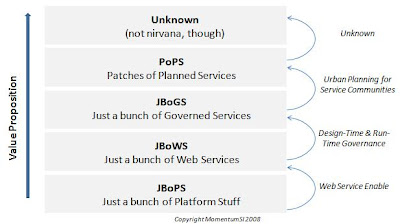
The next evolutionary step is to abandon the concept of application silos and start to establish a service landscape. Jeff speaks of "Patches of Planned Services", which introduce "the 'planning' view of SOA typically thought of as a top-down approach". "Patches" hint at the fact that planning starts at the domain level, gradually expanding service orientation to other domains of the enterprise "one area at a time".

Jeff summarizes the evolution as follows:

Most companies want to get their 'wild services' governed before they move to more ambitious goals. 2008 appears to be the start of the PoPS era. Companies that have matured their JBoGS are now looking for SOA to support business critical processes like order-to-cash [...] This is the driving force for creating planned communities of services which are typically aligned to business processes.

Finally Jeff predicts that PoPS are not the end of the line. The "future remains cloudy", though.

No comments

Reply

Exclusive Content

Business Natural Languages Development in Ruby

Jay Fields presents his concept of Business Natural Languages - a type of Domain Specific Languages geared towards being readable by domain experts.

Distributed Version Control Systems: A Not-So-Quick Guide Through

Adoption and interest for Distributed Version Control Systems is constantly rising. We will introduce the concept of DVCS and have a look at 3 actors in the area: git, Mercurial and Bazaar.

Segundo Velasquez and Agile as Seen Through the Customer's Eyes

Deborah Hartmann interviewed Segundo Velasquez about his experience as customer with an Agile team during the initial phase of software design of a product.

Fine Grained Versioning with ClickOnce

David Cooksey shows how to fine grained versioning to a ClickOnce deployment using an HttpHandler written with ASP.NET, making partial rollouts to a test audience much easier.

Implementing Manual Activities in Windows Workflow

Windows workflow (WF) is an excellent framework for implementing business processes, but lacks support for human activities. This article describes a completely generic approach for changing this.

Markus Voelter about Software Architecture Documentation

In this interview taken during OOPSLA 2007, Markus Voelter talks about the importance of documenting the software architecture, and gives some good and also bad examples on how it could be done.

Voca, UK's largest payment processing engine running Spring

William Soo and Meeraj Kunnumpurath discuss the Voca transaction processing system, architectural challenges and requirements, Voca's Spring/J2EE architecture, and the future SEPA architecture.

Patterns for securing architectures

Security is about trade-offs. Only a few have the expertise to design good security. This talk focuses on Security Patterns, such as Role-based Access Control, Single Access Point, and Front Door.