InfoQ Homepage Agents Content on InfoQ
-
RIIIR: Rewrite it in *Idiomatic* Rust (with AI)
Nicholas Matsakis explains how pairing Rust with AI overcomes traditional learning curves, introducing Symposium and the Agent Client Protocol to build extensible, reliable developer tooling.

-
Opening the Black Box: Critical Explainability for AI Agent Tool Selection with Kiji Inspector
Hannes Hapke explains how to move beyond post-hoc narratives by using Sparse Autoencoders with Kiji Inspector to uncover true causal mechanistic interpretability in production LLM agent decisions.

-
Batch Intelligence at Scale: Cost-Efficient Multi-Agent LLM Workflows with Built-In Resilience
Aditya Mulik shares how Walmart scaled resilient multi-agent LLM batch workflows across 4,700 stores, cutting monthly inference costs by 90% while enforcing semantic validation and bounded retries.

-
Zero Trust Agent Systems that Pass Audits and Still Ship
Advait Patel explains how to secure AI agents in production by moving security boundaries to the tool layer, enforcing workload identity, and capturing structured audit traces for compliance.

-
Panel: Who Builds the Frontend Now? (And What Breaks When They Do)
The panelists discuss AI's impact on frontend architecture, vibe coding risks, agent interfaces, code quality, and open-source sustainability.

-
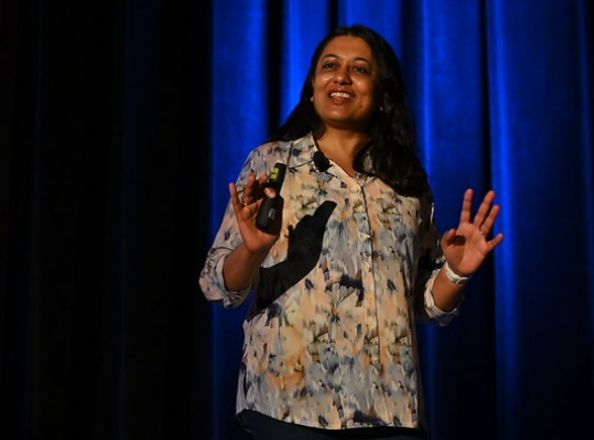
Beyond the Harness: Canvas for AI Agents
Nimisha Asthagiri explains why shifting from rigid harness engineering to a bounded canvas model empowers autonomous AI agents while managing architecture drift and cognitive debt.
-
Actors for Agents: Patterns for Production AI
Manju Rajashekhar discusses why the actor model provides the ideal runtime architecture for moving AI agents from simple demos to production-grade, long-running, fault-tolerant systems.

-
Beyond the Prototype: Scaling Framework Agnostic AI Agent Infrastructure with Ray
The speakers explain how to run and autoscale LLM agents in production using Ray, detailing system architecture, control planes, multi-region deployments, and CI/CD pipelines with LLM evals.

-
Exploding GPUs and the AI Infrastructure Challenge
Andrew Martin explains why AI security relies on Kubernetes security, highlighting new threat vectors like prompt injection, unconstrained agents, and the unique risks facing GPU infrastructure.

-
What 25 Trillion Tokens Reveal about How Developers Actually Adopt AI Agents
Brendan O'Leary shares real-world data from 40T tokens to explain how trust, multi-model routing, and context construction drive actual developer AI adoption over raw benchmarks.

-
Multi-Agent Patterns from Spotify’s AI Powered Advertising Platform
Pratik Rasam explains how Spotify Ads Manager builds multi-agent AI systems in production using Google ADK Java, detailing guardrails, domain ownership, and key architectural patterns for scale.

-
Building Reusable Evaluation Frameworks for Agentic AI Products
Susan Chang shares how Elastic built a production-grade AI agent evaluation framework, detailing lessons on tracing, LLM-as-a-judge, programmatic evals to prevent regression across engineering teams.