AWS recently released Agent Registry in public preview as part of Amazon Bedrock AgentCore, providing enterprises a centralized catalog for discovering, sharing, and governing AI agents, tools, MCP servers, and agent skills across an organization. The registry indexes agents regardless of where they run, whether on AWS, other cloud providers, or on premises.
The problem it addresses will be familiar to any platform team that has watched agent counts climb: nobody knows what exists, who owns it, whether it's approved, or whether the team down the hall already built the same thing. Agent sprawl compounds fast. Compliance gaps follow. Development effort gets wasted on duplicate work.
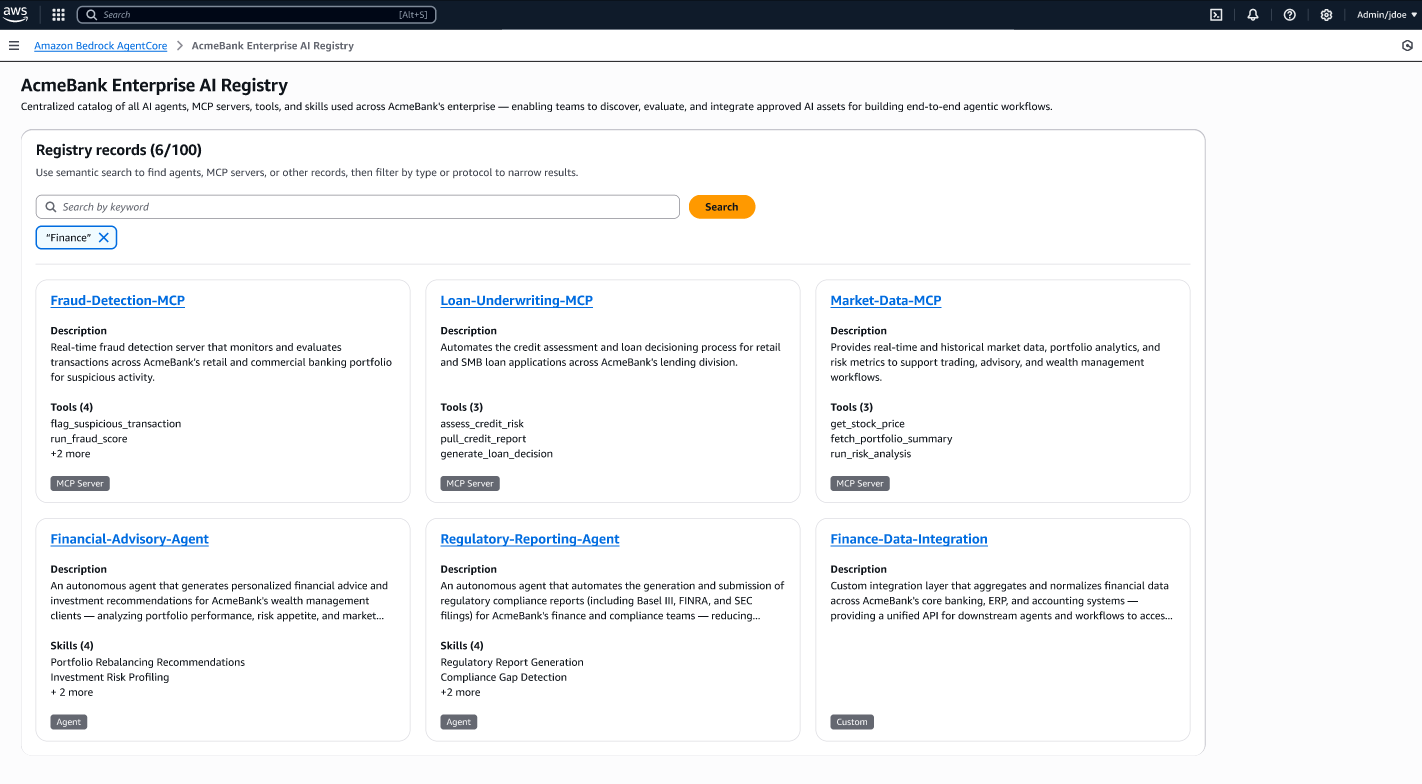
(Source: AWS Artificial Intelligence Blog Post)
There are two ways to register a record. Teams can provide metadata manually through the console, SDK, or API, specifying ownership, capability descriptions, and compliance status. Or they can point to an MCP or A2A endpoint and let the registry pull in the details automatically. Every record captures who published it, what protocols it implements, what it exposes, and how to invoke it.
Finding what already exists relies on a hybrid search that blends keyword and semantic matching. A search for "payment processing" can surface tools tagged as "billing" or "invoicing" even when the names don't overlap. The registry is accessible through the AgentCore console, APIs, and as an MCP server itself, so any MCP-compatible client, including Kiro and Claude Code, can query it directly. For organizations with custom identity providers, OAuth-based access lets teams build their own discovery interfaces without requiring IAM credentials.
On the governance side, records follow an approval workflow. They start as drafts, move to pending approval, and only become discoverable once approved. Admins control who can register and who can discover through IAM policies. Versioning tracks changes over time, and organizations can deprecate records that are no longer needed. Custom metadata fields let teams attach information like cost center, deployment environment, or security classification.
Shinya Tahara, a solutions architect, put the registry through hands-on testing and turned up some rough edges worth knowing about. Semantic search performed well with English queries but stumbled on Japanese queries against English-only metadata. One out of three Japanese test queries returned zero results. Adding bilingual descriptions fixed the problem, a useful finding for any global organization planning to roll this out. Tahara also discovered that folding filter constraints into natural language queries badly degraded precision, returning all registered records instead of the intended target. And updating any record resets its status to DRAFT, which means re-submission and re-approval. Teams managing frequently updated agents should factor that friction into their workflows.
Justin Bundick, VP of AI and intelligent platforms at Southwest Airlines, described the registry's value in the announcement:
AWS Agent Registry in AgentCore addresses the critical discoverability challenge, enabling teams to find and reuse existing agents rather than rebuild capabilities from scratch. With managed governance across multiple platforms, every agent carries standardized ownership metadata and policy enforcement.
Zuora is also an early adopter. The company deploys 50 agents across sales, finance, product, and developer teams. Pete Hirsch, Zuora's chief product and technology officer, noted that the registry gives principal architects a unified view for discovering, managing, and cataloging every agent, tool, and skill in use, with standardized metadata ensuring consistent ownership and capability details across the ecosystem.
Looking ahead, the roadmap includes automatic indexing of agents the moment they deploy, cross-registry federation for searching across multiple registries as one, custom categories and taxonomies, and the integration of operational data from AgentCore Observability, including invocation counts, latency, uptime, and usage patterns, directly into registry records. Moreover, AWS mentioned early partner interest in connecting external catalogs to enable centralized discovery across technology landscapes.
AWS is not the only hyperscaler with an agent registry solution. For instance, Microsoft offers Entra Agent Registry and Azure Agent Registry. In addition, Google Cloud has its own Agent Registry, and protocol-level efforts like the Agent Client Protocol (ACP) Registry also exist. What distinguishes the AWS offering is its provider-agnostic indexing combined with native support for both MCP and A2A protocols, allowing it to catalog agents built outside the AWS ecosystem.
Agent Registry is currently available in preview in five AWS regions: US East (N. Virginia), US West (Oregon), Asia Pacific (Sydney), Asia Pacific (Tokyo), and Europe (Ireland).