AWS has launched the Sustainability console, a standalone service that consolidates carbon emissions reporting into a single place with its own permissions model, a new API, configurable CSV exports, and Scope 1, 2, and 3 emissions data broken down by service and Region. The console is available at no additional cost with historical data going back to January 2022.
AWS CTO Werner Vogels framed the launch in architectural terms in a LinkedIn post, arguing that carbon emissions should become part of the standard observability stack:
When carbon emission becomes just another metric in your observability stack sitting next to latency, cost, and error rates, it stops being a compliance exercise and starts becoming an architectural discipline.
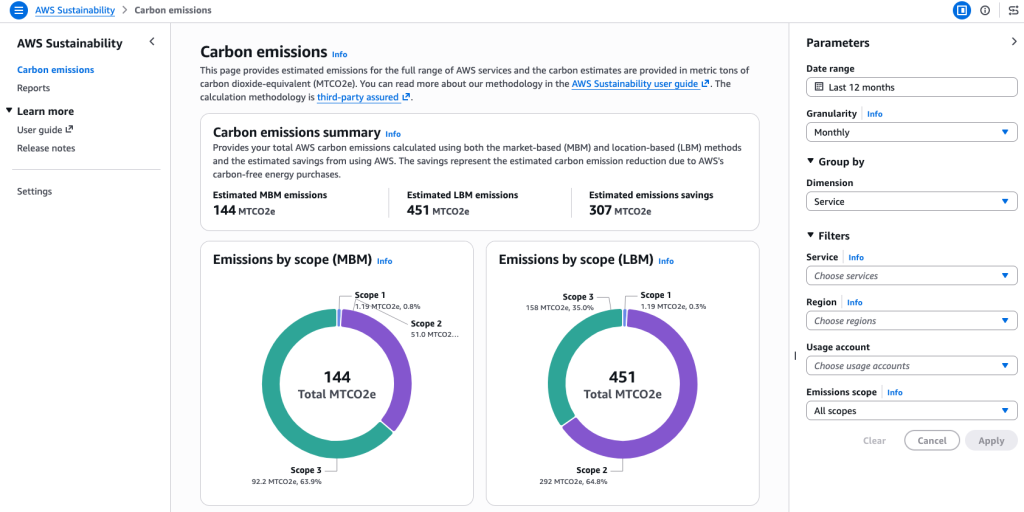
The console builds on the existing Customer Carbon Footprint Tool, which previously lived inside the AWS Billing console. That created a practical friction: sustainability professionals who needed emissions data also needed billing-level permissions to access it. The new console decouples the two, giving sustainability teams direct access through its own IAM permissions model. Teams can download preset monthly and annual reports covering both market-based and location-based emissions methods, build custom CSV exports, and configure fiscal year alignment so data views match their reporting periods rather than the calendar year.
The API is perhaps the most significant addition for engineering teams. Using the AWS CLI or SDKs, organizations can pull emissions data programmatically into their own dashboards, reporting pipelines, or compliance workflows. This is particularly relevant for organizations operating across large numbers of accounts or needing custom account groupings that don't map to their existing AWS Organizations structure.
(Source: AWS News Blog Post)
One practical application of the API, as AWS ambassador Jason Oliver noted in a detailed writeup, is calculating carbon intensity: the amount of carbon emitted per unit of work. By correlating the API's emissions data with application performance metrics, teams can identify carbon-heavy architectural patterns. Oliver argues that total emissions are a vanity metric for growing businesses, and that carbon per transaction or per request is the measure that actually drives engineering decisions.
The regulatory context gives this launch additional weight. Harry Mylonas, a principal AWS architect specializing in governance, noted on LinkedIn that the timing aligns with the EU's Corporate Sustainability Reporting Directive (CSRD), calling ESG reporting "a strict, data-heavy regulatory mandate" rather than a soft PR initiative. For European enterprises subject to CSRD, having Scope 1-3 data accessible via API and exportable in configurable formats addresses a concrete compliance need.
Not everyone is convinced the console goes far enough. Christopher Galliart, an AWS-certified solutions architect, pointed out that the API delivers monthly aggregates rather than real-time data. "For edge and IoT architectures where devices are deciding between local processing, batching, or offloading, emissions as a real-time signal changes those tradeoffs," he wrote, questioning whether routing-level granularity is on the roadmap or whether the console will remain account-level reporting.
The underlying emissions data and methodology have not changed with this launch. AWS notes that these are the same calculations used by the existing Customer Carbon Footprint Tool, independently verified by Apex. What has changed is how teams can access and work with that data, which, if Vogels' meter analogy holds, may be the part that actually matters.