Mathematicians proved in the early 1990s that randomly connecting routers produces the most efficient, resilient network topology. It took AWS roughly 30 years to turn that result into production infrastructure. The company disclosed that Resilient Network Graphs (RNG), a flat network architecture based on quasi-random graph theory, is now the default for most new non-GPU AWS data center builds globally.
In a paper posted to arXiv, Giacomo Bernardi (principal applied scientist at AWS), Ratul Mahajan (University of Washington, Amazon Scholar), and Seshadhri Comandur (UC Santa Cruz, Amazon Scholar) describe it as the first large-scale production deployment of expander-based network fabrics. The numbers: 69% fewer networking devices, up to 33% higher throughput, and a projected 40% reduction in network equipment power consumption.
To understand why this matters, start with what it replaces. Traditional data center networks use a fat-tree topology: servers connect to top-of-rack (ToR) switches, which connect to aggregation switches, which in turn connect to spine switches. Traffic between two servers on different racks has to climb the hierarchy to a shared spine and back down. If those spine links congest, throughput drops even when bandwidth elsewhere is plentiful. Adding capacity means adding entire switch tiers, which is expensive and power-hungry.
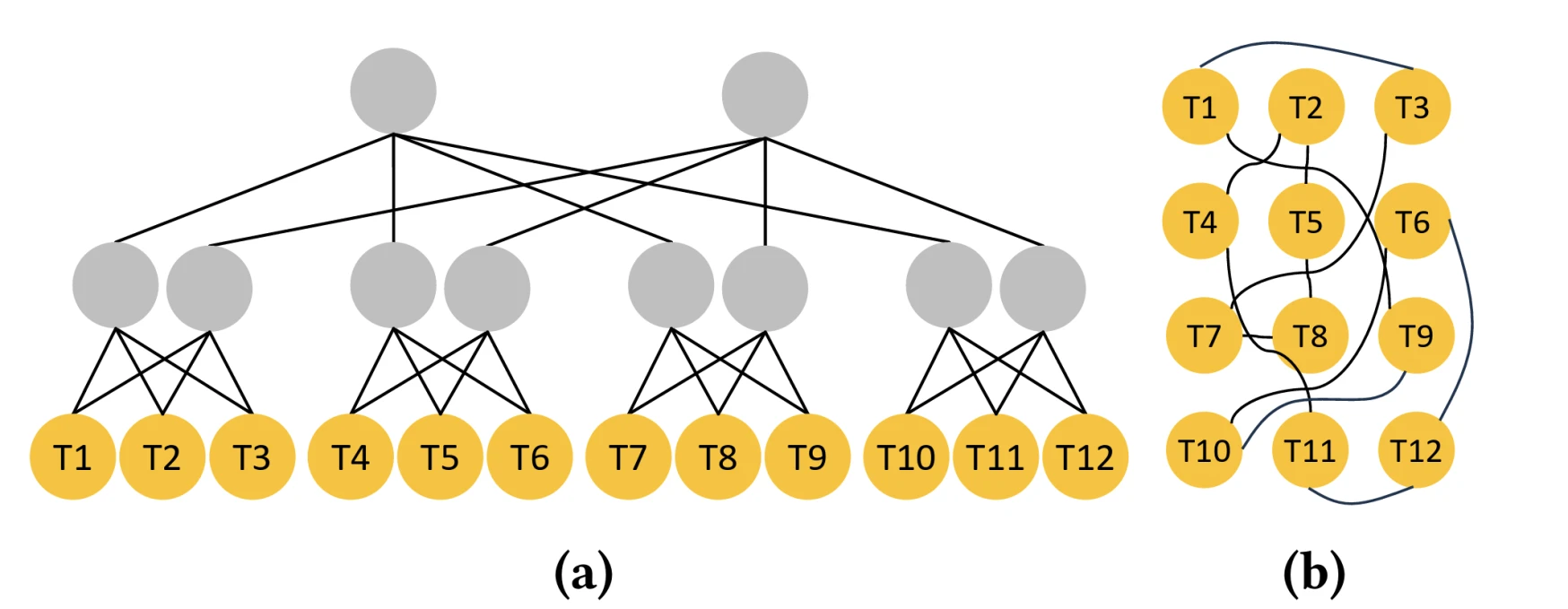
(Source: Amazon Science blog post)
As one practitioner on Reddit put it, the key insight is that RNG is "a physical topological challenge rather than a routing challenge explicitly":
The key aspect of it is having a sufficient number of nodes capable of routing traffic and then quasi-randomising their connectivity via the passive optical ShuffleBoxes. This will, on average, reduce hot links while also reducing the need for expensive higher bandwidth aggregated links.
In concrete networking terms, as another commenter explained, what AWS actually did was replace the spine and leaf layers entirely: "a mesh of ToR switches directly connected to random other ToR nodes via those inter-rack uplink cassettes." The hierarchy is gone. Every rack connects directly to a quasi-random set of other racks.
Making that work required solving two problems. The first was physical cabling. You cannot literally run random wires across a data center at hyperscale. AWS built ShuffleBox, a passive optical device with internally shuffled fiber wiring. It makes the logical topology quasi-random while keeping physical cabling as straightforward as plugging into a local port. Because ShuffleBoxes are passive, they add no latency, consume no power, and introduce no failure mode.
The second was routing. With no hierarchy to guide packets, traffic needs a different strategy. AWS built Spraypoint, a custom distributed protocol that sprays traffic simultaneously across neighboring routers and uses designated waypoints to guide packets to their destinations. Spraying packets down multiple routes sounds wasteful, but as one Reddit commenter observed:
Spraying the same packet down multiple routes sounds inefficient, and at first glance doesn't seem like it would make things faster at all... but when you think about it, if you need multi-path redundancy with no performance loss built into your network already, why not just go ahead and use that bandwidth for packet copies, instead of just leaving it idle.
The resilience property may be the most compelling argument for practitioners evaluating network architectures. In a fat-tree topology, losing a spine switch cascades into catastrophic bottlenecks for every rack below it. In an RNG topology, losing 1% of routers results in roughly a 1% loss of capacity. The network degrades proportionally rather than catastrophically, because random graphs distribute connectivity so evenly that no single node is a bottleneck.
Validation was extensive before production deployment as the team ran 530 processor-years of simulation on EC2 across dozens of traffic patterns. The first production network went live near Dublin, Ireland, at the end of 2024. AWS completed three deployments for validation and refinement at facilities in Ireland, Germany, and Spain before making RNG the default in April 2026. The arXiv paper reports cost savings between 9% and 45% compared to fat-tree designs, with equal or better performance. No customer workload changes were required.
One important scope limitation: RNG targets general-purpose compute, where traffic patterns approximate a random distribution. AI training generates coordinated, centralized traffic that doesn't fit this model, so AWS continues using its UltraServer architecture for GPU clusters.
The question for the industry is whether this remains an AWS-specific advantage or becomes an architecture that other operators adopt. Google, Microsoft, and Meta have all published research on alternatives to fat-tree fabrics, but none have disclosed a production deployment of expander-based networks at a comparable scale.