TypeSafe AI, a San Francisco lab founded by former OpenAI researcher Diogo Almeida, has released Jev, the first of what it calls System One Models. Jev does not generate text. It returns typed, probabilistic decisions that software can act on directly.
A caller sends a state, either a string or structured data, together with a set of typed questions. Jev evaluates them all in a single parallel pass and returns Choice, Score and Noul answers with a probability distribution and a confidence value, so calling code can act above a threshold and escalate below it. Input costs $0.042 per million tokens, output is free, the context window is 32,000 tokens, and TypeSafe quotes end to end latency of 70ms to 500ms. Training uses a method it calls Reinforcement Learning for Calibrated Decisions.
Vercel, which added Jev to AI Gateway on day two, said it reached nearly 13% of paid teams within 24 hours, twice the share of the GPT-5.6 family. Netlify followed, LangChain shipped a TypeSafeClassifier integration with model routing and an AutoMode middleware that screens tool calls before they run, and five independent Elixir clients appeared within days.
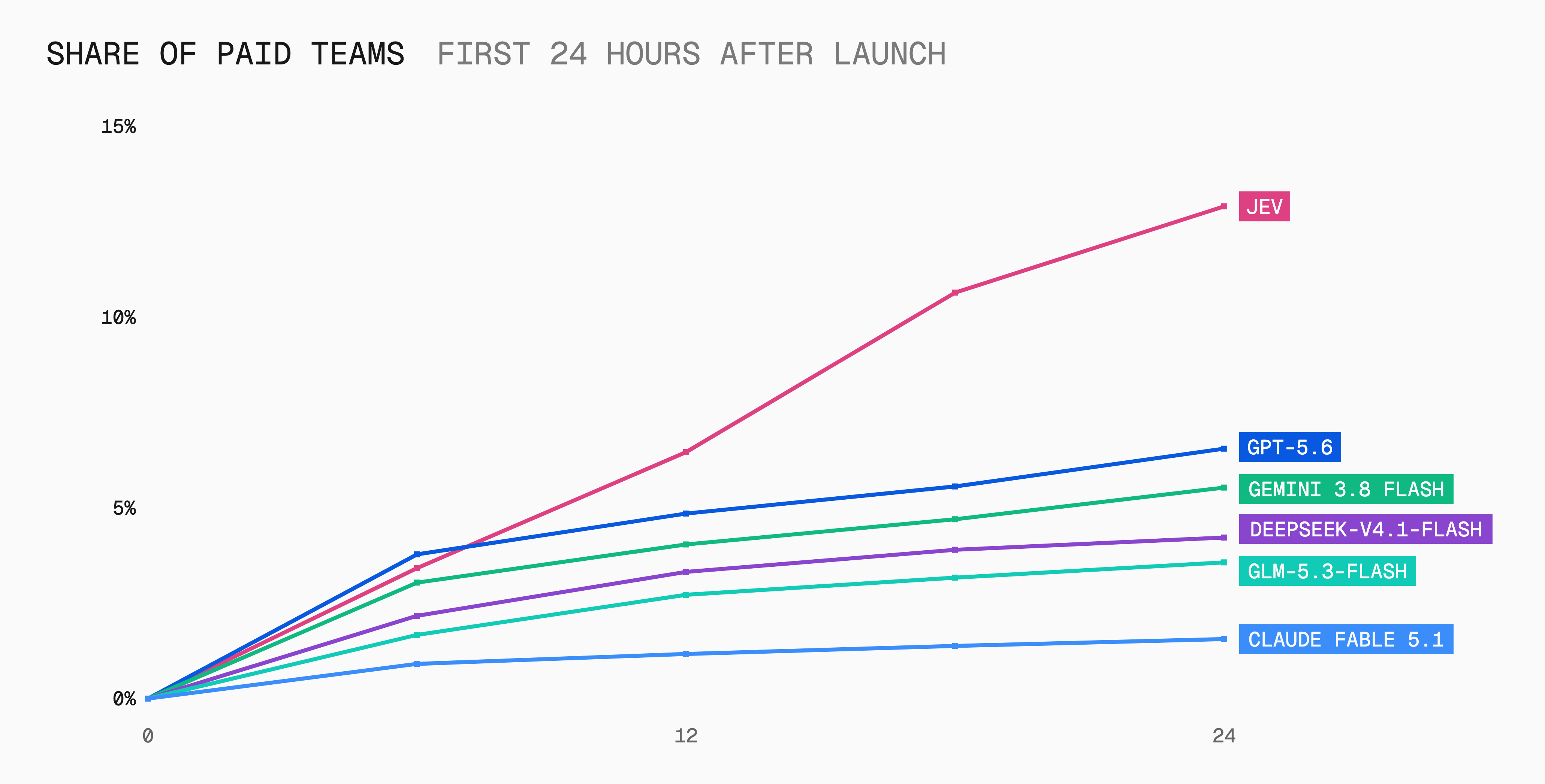
First day adoption of Jev on Vercel AI Gateway compared with other recent model launches. Credit: Vercel
Vercel engineer Pranit Sharma found a safety classifier ran five to 18 times faster than the LLM it replaced, while Bryo AI CTO Nikhil Mudholkar rated Gemini slightly more accurate on email classification but 10 to 20 times more expensive, and valued Jev as the only one handing back a real probability. Armin Ronacher, CTO of Earendil, told TechCrunch the design "delegates the hallucination problem a little bit to the user", who has to decide whether a 50% probability is worth acting on, and pointed to model routing as another good fit. An analysis of 12,759 launch tweets by OpenChamber put user reported speedups at a median of 7x against the 193.6x headline, cost savings at a median of 30x, and latency at a median of 76ms with an upper quartile of 270ms.
One developer on Reddit called the model "absolutely insane" for agent work at 200ms to 300ms latency, and an early access user on Hacker News called it "really neat" while cautioning that its out of distribution behaviour will differ from an LLM.
On Hacker News, one developer noted that Jev cannot emit an invalid type but can still emit a completely wrong valid value:
First, congrats to the team on launching something genuinely interesting and new.
Seems like a more accurate title would be "Jev: Trading general purpose generation for fast typed inference" or something like that.This is interesting, but the speed comparison seems misleading? A generative model that can output code in a Turing-complete language can do anything a computer can do.
Jev can only generate structured output, right? This is probably super useful for classification/routing/scoring, but it's nothing like the code generating models we're all using today for code and automation.
Also "can't hallucinate" seems wrong? Sure, it can't emit an invalid type, but it can still emit a completely wrong valid value. You can enforce structured output from an LLM too, with an appropriate harness, etc.
Teams replacing LLM classifiers should start with the jev-1.13 jaggedness page, which documents unreliable counting, arithmetic and date comparison, plus accuracy loss on large noisy state, and advises keeping maths in code. Pin a version such as jev-1.13.0 rather than the moving jev-latest and jev-preview aliases, and use the System One adapter to run existing models against the same schema when benchmarking. The quickstart covers keys, SDKs and the playground.
TypeSafe AI is an AI lab based in San Francisco, founded by Diogo Almeida, Erik Gafni and Sasha Sheng. Almeida co-invented RLHF and worked on the research behind ChatGPT.